
Digital Accessibility Trends 2026 (POSTER)

2025 saw major shifts in accessibility – the field is evolving fast. And it’s increasingly shaping digital and marketing performance, customer trust and commercial risk.
From updates in enforcement of laws via monitoring bodies, to the appearance of large numbers of new AI-based accessibility tools, accessibility being challenged by vibe coding and the likes of lovable, how accessibility of content could help Agentic AI, and the best way to embed the continued need for human oversight – organisations need to keep up with fast moving change.
To help you navigate the year ahead, we’ve created a free poster outlining the Top Accessibility Trends you need to know for 2026.
And, if you want more detail on any of these trends, watch the recording of the webinar in January 2026 when I took 300+ people through them live.
The poster
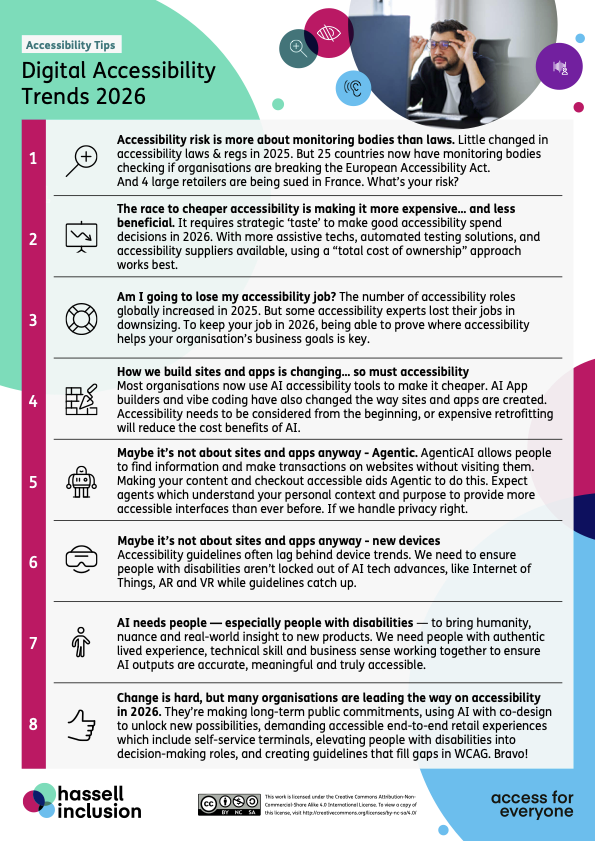
Here’s an image of the poster. Click here for the full text of the poster.
Download the poster
Download the poster (PDF) now to discover what’s shaping the future of accessibility and how your organisation can stay compliant, inclusive, and competitive.
Transcript of the text on the poster
1. Accessibility risk is more about monitoring bodies than laws
- Little changed in accessibility laws & regs in 2025. But 25 countries now have monitoring bodies checking if organisations are breaking the European Accessibility Act.And 4 large retailers are being sued in France. What’s your risk?
2. The race to cheaper accessibility is making it more expensive… and less
beneficial
- It requires strategic ‘taste’ to make good accessibility spend decisions in 2026. With more assistive techs, automated testing solutions, and accessibility suppliers available, using a “total cost of ownership” approach works best.
3. Am I going to lose my accessibility job?
- The number of accessibility roles globally increased in 2025. But some accessibility experts lost their jobs in downsizing. To keep your job in 2026, being able to prove where accessibility helps your organisation’s business goals is key.
4. How we build sites and apps is changing… so must accessibility
- Most organisations now use AI accessibility tools to make it cheaper. AI App builders and vibe coding have also changed the way sites and apps are created. Accessibility needs to be considered from the beginning, or expensive retrofitting will reduce the cost benefits of AI.
5. Maybe it’s not about sites and apps anyway – Agentic
- Agentic AI allows people to find information and make transactions on websites without visiting them. Making your content and checkout accessible aids Agentic to do this. Expect agents which understand your personal context and purpose to provide more accessible interfaces than ever before. If we handle privacy right.
6. Maybe it’s not about sites and apps anyway – new devices
- Accessibility guidelines often lag behind device trends. We need to ensure people with disabilities aren’t locked out of AI tech advances, like Internet of Things, AR and VR while guidelines catch up.
7. AI needs people — especially people with disabilities
- Needed to bring humanity, nuance and real-world insight to new products. We need people with authentic lived experience, technical skill and business sense working together to ensure AI outputs are accurate, meaningful and truly accessible.
8. Change is hard, but many organisations are leading the way on accessibility in 2026
- They’re making long-term public commitments, using AI with co-design to unlock new possibilities, demanding accessible end-to-end retail experiences which include self-service terminals, elevating people with disabilities into decision-making roles, and creating guidelines that fill gaps in WCAG. Bravo!